Why a Homemade Scorecard Makes Any Game Easier to Join
A homemade scorecard gives newcomers a clear way into a group game, with visible rules, shared turns and simple paper that needs no special kit.
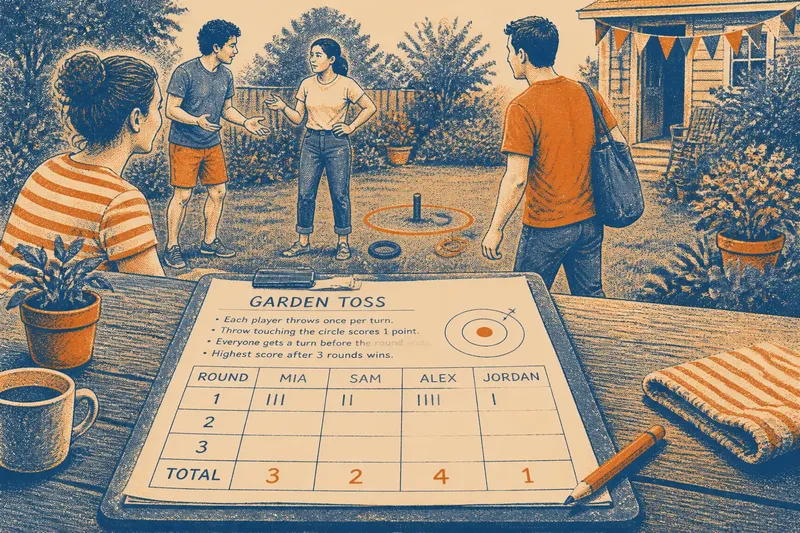
Someone arrives halfway through a garden game just as the players start arguing about whether a close throw counts. A homemade scorecard can settle the rule, show whose turn comes next and let the newcomer join without learning a private system by guesswork. A scrap of paper and a pencil are enough; the useful part is agreeing what to write before play begins.
Think of the card as a small welcome mat for the game. It does not need to record every detail or make a relaxed pastime feel like a tournament. Its job is to keep the important decisions visible, so people can spend less time asking what happened and more time taking part.
What should a homemade scorecard make clear?
Start with the questions a new player would naturally ask: What counts as a turn? What earns a point? When does a round end? How can someone tell whose turn is next? The answers should fit in a few short lines, in language the group would actually use.
Write the rules that affect play, not every possible edge case. For a simple target-toss game, that might mean each player throws once per turn, a throw touching the marked zone scores, and everyone gets another turn before the round ends. If the group has not settled a detail, choose a straightforward rule together and put it on the card.
Keep scoring equally legible. A column for each player and a row for each round is often enough; use tally marks or a single numeral, not a special code that only the regulars understand. Leave a little room to correct an entry cleanly, because a visible correction is less confusing than a quiet alteration.
How can you prepare the card across a week?
A short routine makes the card useful without turning it into a project. If your group meets regularly, use the days before a game to settle the wording, bring the necessary paper and make a quick check when people gather.
- At the first planning chat: Decide which game the group will play and name the rules a newcomer must know. Keep the conversation to turn order, scoring and the end of a round unless another rule genuinely changes how people participate.
- A day or two before play: Draft the card on scrap paper. Put the game name at the top, list the agreed rules underneath and draw a score grid with enough space for the expected players. Avoid decorating it before checking that the writing is easy to read.
- Before the game starts: Lay the card where the group can see it. Read the brief rules aloud, invite questions and give newcomers a chance to suggest a wording change if something remains unclear.
- After the first round: Pause briefly to check that the card matches what people actually did. If the group agreed on an adjustment, cross out the old wording once and write the new rule clearly rather than letting two versions circulate.
- After the game: Decide whether the card is worth keeping for the next gathering. If the group often changes the game, save the basic layout and rewrite the rules next time; if the game was a one-off, there is no need to preserve a paper record.
That rhythm works for a weekly meet-up, but it can be compressed into a single afternoon: agree, draft, read aloud, play a round, then revise. The point is to make the card responsive to the group, not to create paperwork that outlasts the fun.
What belongs on the card, and what does not?
Use the front for information players need while taking part: names or initials, turn order, scoring and the finish condition. If a rule is easier to show than describe, add a tiny sketch, such as a marked target area, rather than a paragraph of explanation.
Leave out elaborate rankings, running totals across unrelated games and penalties nobody has agreed to. Those additions can make a casual game feel harder to enter, especially if a newcomer worries that one mistake will spoil the record. A scorecard should clarify the game, not judge the people playing it.
Nor is it worth spending time finding matching pens, laminating the sheet or drawing a perfect grid. A blunt pencil, the back of an old envelope or a folded sheet can do the job. If rain or wind is likely, choose a sheltered place for the card or use a firmer surface beneath it; don’t turn the materials into the main event.
How do you keep the score fair and welcoming?
Agree who writes before the first turn, and make that person’s role easy to pass on. One player can mark the score while another calls out the result, then they can swap next round. This spreads the small task around and gives newcomers a natural way to help without requiring them to know the whole game already.
Make entries as they happen rather than relying on memory at the end of a round. When a result is disputed, stop and refer to the written rule; if it does not answer the question, let the group choose a rule for that moment and add it if it is likely to recur. Keep the decision brief so a minor uncertainty does not become the game’s main activity.
Use names or initials that everyone can recognise, and ask before writing anything personal beyond what the game needs. If someone would rather not have their name on the sheet, a chosen nickname or seat position may be enough. The card is there to help people participate, not to create a record that must be kept or shared.
Which homemade scorecard questions come up most often?
What if the game has no points?
Use the card to track turns, rounds completed or which team starts next. A visible sequence can orient newcomers even when nobody is trying to win.
How many rules should the card include?
Include only the rules needed to take a turn, recognise a result and know when play ends. If players need a long explanation before they can begin, simplify the game or explain one extra rule at the moment it matters.
Can a newcomer keep the score?
Yes, if they want to and the group explains the marks before play. Pairing them with a regular player for the first round makes the job clear without treating the newcomer as an observer.
What if players disagree about a result?
Pause, check the rule on the card and agree on a decision for the current turn. If the wording is unclear, revise it together before the next round rather than letting the same uncertainty follow the group.
How does one card help a newcomer settle in?
Say a neighbour joins a casual ring-toss game after the first round. The card already shows the throwing order, the marked scoring area and the rule that each player gets one throw per turn. A regular points to the next name and explains the score marks; the newcomer can take a turn, see how it is recorded and follow the next round without asking the group to restart.
That small act of visibility changes the social feel of a game. The newcomer is not expected to remember a string of spoken instructions, and the regulars do not have to keep interrupting play to repeat them. If the card’s wording still leaves someone unsure, that is useful information: the group can make the rule clearer rather than assuming the person should have understood.
A homemade scorecard works best when it stays modest, readable and open to revision. For your next group game, write down only what a new player needs to begin, put the sheet where everyone can see it, and let the first round reveal what needs clarifying. The score may matter to the players; the card’s more useful result is that nobody has to stand at the edge wondering how to join.